



Midnight, and a birthday group leaves the VIP room in high spirits. One guest slips two banknotes to the room server. Another tells the cashier to "add some extra to the bill for him". A third transfers more than the total and says "keep the change for the staff". Three tips take three different routes, and only the first one is sure to reach the right person. The other two sit in the venue's cash fund or bank account. If nobody records them, staff think the venue kept the money, while the owner sees unusually high revenue for that night without knowing why.
Three kinds of tips at a karaoke venue and where the money sits
| Kind of tip | Where the money sits | What often happens | What to do |
|---|---|---|---|
| Cash handed over directly | The staff member's pocket | Staff serving other rooms feel short-changed if the venue says tips are pooled | State clearly whether cash tips are kept or go into a shared pool |
| The guest asks to add it to the bill | The venue's cash fund or account | It mixes into revenue, and by the end of the shift nobody remembers whose it was | Record the tip against the right room and the right person at payment |
| Overpaid transfer, "keep the change" | The venue's account | The cashier treats it as surplus and the staff never know they were tipped | The cashier asks the guest one question, then records it as a tip |
Money in a staff member's pocket does not need managing by the venue. Money that passes through the venue's fund is being held on the staff's behalf, and it must be paid back in full.
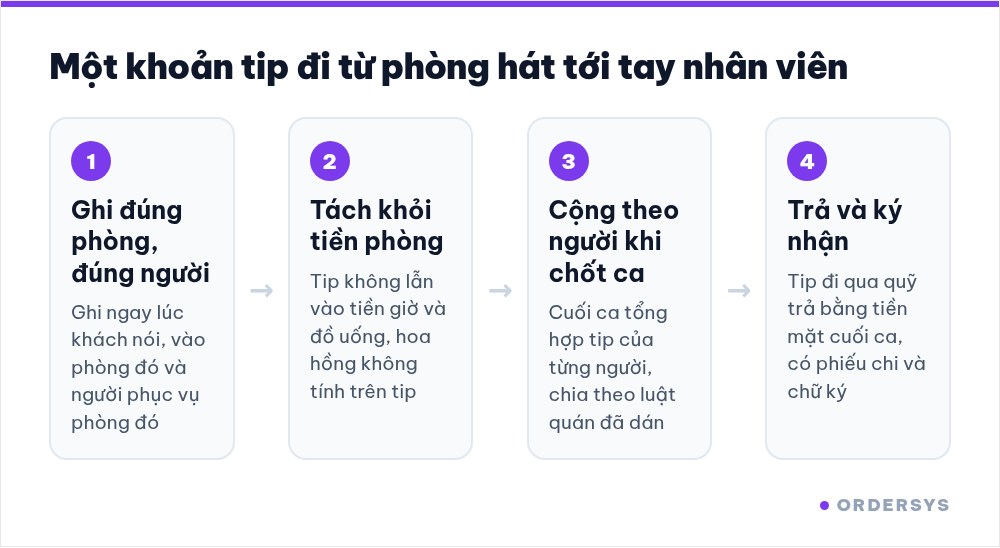
Individual tips or a shared pool
No single method suits every venue. What works depends on how the venue assigns room servers:
- Each keeps their own: suits venues where each person covers a fixed block of rooms during a shift. The downside is that whoever covers a quiet block gets fewer tips, through no fault of their own.
- Pooled and split per shift: suits busy rooms served by several people, one carrying beer, one swapping microphones, one cleaning up. Split by hours worked in the shift; do not split equally per head if someone leaves early.
- A mix: cash tips handed over directly stay with the person, tips that go through the bill are pooled. This causes the fewest arguments at small and medium venues.
Whichever you choose, write it down and post it in the staff room, including whether the shift manager gets a share. Changing the rules halfway through is the fastest way to lose the goodwill of night-shift staff.
Record tips at the moment of payment
- Record it against the right room and the person serving that room. Do it as soon as the guest says so, because recalling at the end of the shift always misses some.
- Keep tips separate from room time and drinks. If tips mix into drink revenue, sales commission gets calculated on the tips too, and that night's revenue report is inflated.
- One account per person. A tip recorded to a staff member clearly belongs to that person, with no need to ask the whole shift.
When and how to pay out tips
- Pay at the end of the shift, with a signature. Tips that came through the bill or a transfer are paid in cash from the fund at shift end, with a payment voucher signed by the staff member. The shift close still balances because the outgoing money has a record.
- Do not hold them until month end and add them to wages. Night-shift staff need to see the money right away. Holding it for long breeds suspicion, even if the venue means nothing by it.
- Do not use tips to cover breakages. A broken glass or missing beer is handled separately, with a record. Deducting it from tips makes staff lose trust in the whole way tips are recorded.
Each week, the owner should look at total tips by person and by shift. Shifts and people who are tipped consistently are a sign of satisfied guests. Someone who was tipped regularly and suddenly drops off is also worth a conversation.
What Ordersys handles
In the Ordersys karaoke management software, tips are recorded by room and by serving staff member, and at the end of the shift they are totalled per person so they can be shared transparently. Each staff member uses their own account, permissions to cancel rooms and give discounts are set by role, and the shift close reconciles cash and transfers against the fund. Venues can try it free for 7 days.
Read more: Karaoke room servers: shifts and drink commissions · Closing the night shift at a karaoke venue: reconciling room fees, drinks and cash.
Staff take orders on their phones, the kitchen gets them instantly, guests order and pay by QR, owners see revenue remotely.
Other news

Duplicate customers in your list: how to merge them without losing history
One customer with three profiles means points split three ways, never reaching a higher tier, and reports counting them as new customers. Five sources of duplicates, the signs to look for, how to merge while keeping purchase history and loyalty points, and counter habits that stop duplicates from the start.

Booking deposits for nail salons in peak season: who to ask, what to say, where the money goes
In peak season, every missed booking wastes a prime time slot of your best technician. Which bookings need a deposit and which do not, three things to say when you take one, which technician it holds, and how the deposit moves through the software so the cash fund still matches at the end of the day.
QR digital menu: change prices and hide sold-out dishes without reprinting
A QR menu can change right away without reprinting, but you need the right switch. Three ways to stop customers ordering a dish by QR, whether a price change affects dishes already ordered, what the kitchen's Sold out button really does, and a three-step routine for busy hours.

Tracking spa appointment status: arrived, late or cancelled
The hard part of spa appointments is not writing them down but knowing what state each one is in right now. Six statuses and what reception should do at each, how to handle no-shows, and how to cancel and undo bookings while deposits still match the cash book.

Transferring a billiard table: keep time played and items ordered, charge each table correctly
Guests switching tables mid-session is routine at a billiard hall. Press Transfer table and the time played closes at the old table's price, further time runs at the new table's price, and ordered items travel with the bill. This article shows how the bill looks, when a transfer is not possible and where the owner can review it.
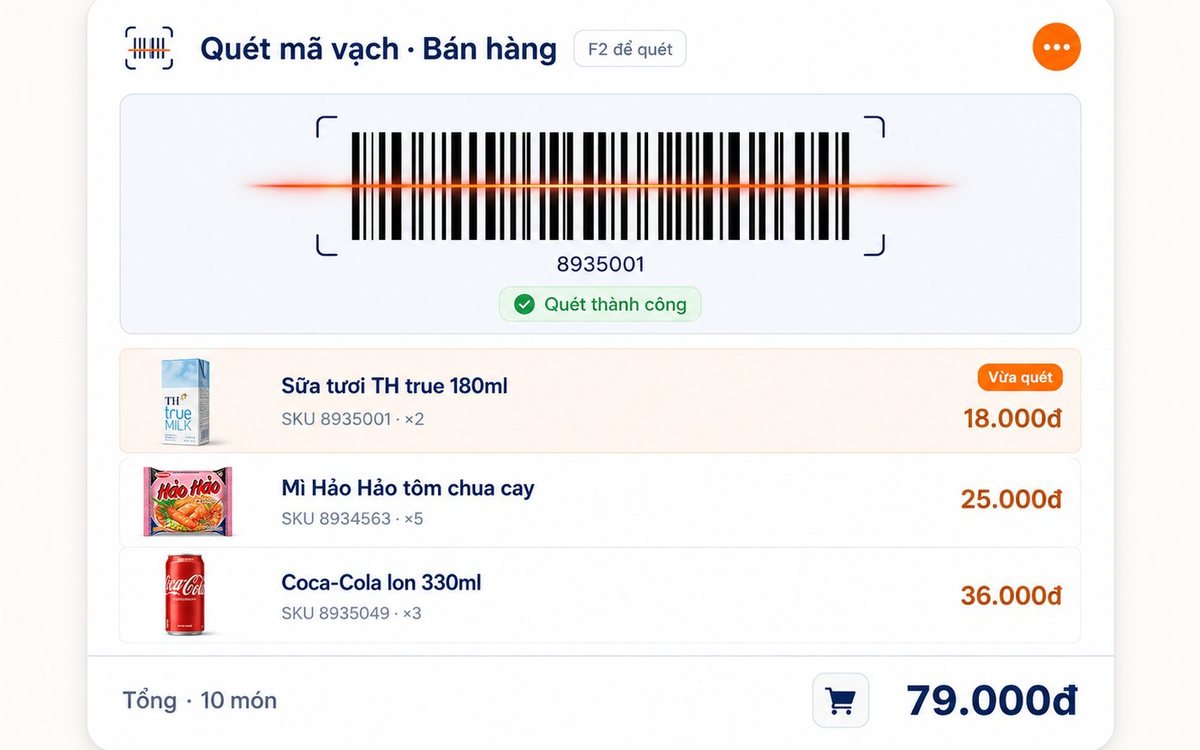
Pharmacy and grocery software: barcodes, expiry dates, fast selling
Pharmacies and grocery shops struggle the same way: many items, small values, a customer waiting, and stock with expiry dates. Barcode selling, lot and expiry travelling with the goods from receipt, case-to-box conversion, stock levels — and one point pharmacies should ask about before choosing software.

Paying part-time staff by the hour in restaurants and coffee shops
Monthly salary does not fit part-timers on four or five-hour shifts with a roster that changes weekly. The four things to set up properly — shifts, attendance, the hourly rate, the closing cycle — and why worked hours must come from attendance rather than from the roster.

Massage shops: booking rooms, beds and therapists without overlaps
Two customers on one bed is the kind of mistake that loses guests quietly. The three sources of overlap in a massage shop, how the software blocks bed conflicts using start time plus duration and a buffer on both sides, what the machine guards and what people still have to, and four rules to agree on before switching on.

Bakery management software: production recipes, expiry dates and cakes ordered for a pickup date
A bakery is a small workshop stuck to a shop, so software that only sells still leaves the owner guessing how much flour went into a batch. Declare baked goods as produced items with recipes, sponge and cream as semi-finished goods, receive materials by lot with expiry dates, sell at the counter with barcode labels, and keep every advance cake order in one place.
